
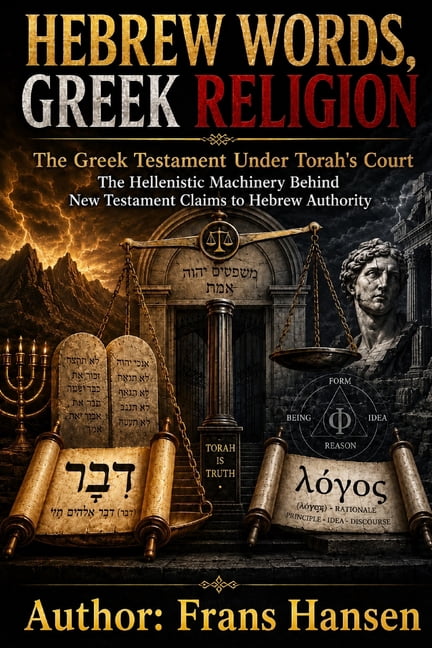
Hebrew Words, Greek Religion: The Greek Testament Under Torah's Court, (Paperback)
Product details
| Management number | 238822999 | Release Date | 2026/07/11 | List Price | US$6.00 | Model Number | 238822999 | ||
|---|---|---|---|---|---|---|---|---|---|
| Category | |||||||||
<p>What if the New Testament did not simply fulfill the Hebrew Bible?</p><p>What if it borrowed Hebrew words, lifted them out of Moses' courtroom, and placed them under a different religious control system?</p><p><b>Hebrew Words, Greek Religion</b> is a Torah-first forensic examination of the New Testament's deepest theological machinery. Its central charge is precise: the New Testament often preserves Hebrew vocabulary while shifting the controlling meaning into Greek, Hellenistic, philosophical, mystical, rhetorical, or later church-doctrinal categories.</p><p>This book does not argue that every Greek word is corrupt. It does not claim that every New Testament idea was copied directly from paganism. That would be too crude and too easy to dismiss.</p><p>The argument is sharper.</p><p>When the New Testament speaks of God, Messiah, Torah, atonement, faith, blood, flesh, spirit, covenant, kingdom, priesthood, sonship, Logos, and redemption, who controls the meaning?</p><p>Moses and the Prophets?</p><p>Or a later religious system built around incarnation, divine sonship, faith over Torah, blood mechanism, heavenly priesthood, church-body identity, and spiritualized redemption?</p><p>Frans Hansen puts the New Testament on trial under the standards of the Hebrew Bible itself. The courtroom is not church tradition. The judge is not Paul. The appeal court is not later Christian theology. The test is Torah.</p><p>Inside this book you will find: </p><p>A clear Torah-court method for testing New Testament claims<br>A Seven Pillars framework covering God, Messiah, Torah, Atonement, Human Nature, Covenant People, and Kingdom/Redemption<br>A direct analysis of Logos, incarnation, divine sonship, Paul's law theology, blood atonement, flesh/spirit language, dying-and-rising participation, and the delayed kingdom<br>A full New Testament drift atlas exposing repeated places where Hebrew concepts are moved under non-Hebrew control<br>A statistical verdict chapter showing the scale of the drift across the New Testament<br>A direct Torah-jurisdiction conclusion on whether the New Testament can stand as authorized revelation from HaShem through Moses</p><p>The book's conclusion is not soft: under Moses' own standards, the New Testament fails as covenant-authoritative revelation. It may be a powerful religious text. It may have shaped world history. It may contain Hebrew words, Jewish names, scriptural quotations, and moral teachings.</p><p>But Hebrew words do not prove Hebrew authority.</p><p>If the meaning has been moved, the religion has been moved.</p><p>This book is written for Christians willing to test what they inherited, Jews and Noahides seeking a structured answer to missionary claims, former Christians rebuilding faith on Tanakh, and serious Bible readers who want more than slogan-level debate.</p><p><b>Hebrew Words, Greek Religion</b> asks the question Christianity avoids: </p><p>Did Moses authorize this?</p>
- Hebrew Words, Greek Religion: The Greek Testament Under Torah's Court, (Paperback)
- Author: Frans Hansen
- ISBN: 9798184583266
- Format: Paperback
- Publication Date: 2026-06-27
- Page Count: 110
| Book format | Paperback |
|---|---|
| Fiction/nonfiction | Non-Fiction |
| Genre | Religion |
| Publication date | June, 2026 |
| Pages | 110 |
| Subgenre | Judaism |
| Series title | No Series |
| Number in series | 0 |
| Edition | 1 |
| Publisher | Amazon Digital Services LLC - Kdp |
| Language | English |
| Is collectible | N |
| Recording time | 0 min |
| Retail packaging | Single Piece |
| Assembled product dimensions (l x w x h) | 6.00 x 0.28 x 9.00 in |
| Assembled product weight | 0.32 lb |
| Bisac subject heading | Religion |
Bestseller ranking
New Testament Criticism & Interpretation



Customers who viewed this product also viewed
Outdoor Fall Pillows



Correction of product information
If you notice any omissions or errors in the product information on this page, please use the correction request form below.
Correction Request Form